On March 27, a conference titled “Et mets ei läheks metsa” was held at the Riigikogu, focusing on the biodiversity, management, and future of Estonian forests. Researchers from FutureScapes Ecosystem Management Team, Kadri Runnel and Raul Rosenvald, also presented their views at the event.
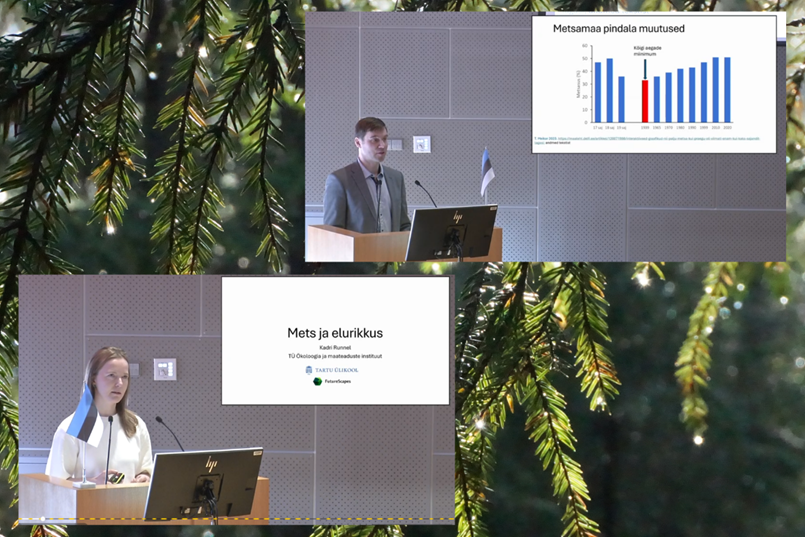 Kadri and Raul giving presentations.
“Protected areas alone are not sufficient to preserve forest biodiversity.”
In her presentation, Kadri Runnel emphasized that protected areas alone are not sufficient to preserve forest biodiversity. No matter how well the network of protected areas is designed, it cannot, by itself, ensure the survival of all forest biodiversity. Many species require larger, connected habitats to maintain viable populations than protected areas alone can provide. In addition, managed forests are also home to a large number of forest species. She noted that relatively small changes—such as leaving retention trees or dead standing trees—would often be enough to maintain these habitats. However, such simple and cost-effective measures are often not implemented in practice, for example because they make it more difficult for harvesters to maneuver.
Kadri also pointed out that there are approximately 20,000 forest species in Estonia, about 10% of which are old-growth forest species that can only live in the conditions of mature natural forests. However, these proportions are not fixed, as the status of species changes continuously and depends on forest conditions and management practices. For example, just a decade ago, many species that in Scandinavia are restricted to old-growth forests were still able to live in Estonian managed forests due to the availability of suitable habitats. Today, however, the situation has changed significantly: managed forests are being harvested at younger ages, and habitats important for biodiversity either do not have time to develop or are removed during logging.
“Sustainable forestry ensures the availability of timber resources for future generations in at least the same quantity.”
Raul explained in his presentation that sustainable forestry means using timber resources in a way that ensures their availability for future generations in at least the same quantity. However, in the case of RMK (State Forest Management Centre), projections suggest that within about 60 years, logging volumes in pine forests could decrease by up to threefold. According to the Forest Europe framework, which Estonia has committed to follow, harvesting volumes should not exceed the net increment of managed forests. However, a closer look shows that in Estonia, harvesting has exceeded net increment for the past seven years.
As one possible solution, Rosenvald proposed abolishing diameter-based maturity thresholds. This would allow, in particular, more productive pine stands to grow longer—while they are currently often harvested at around 60 years of age, they could instead be managed up to 90–100 years. At the same time, harvesting cannot be postponed indefinitely for all tree species, as wood quality declines over time. Therefore, it is important to find balanced approaches and identify where longer growth periods are most appropriate.