Ilona Tamm, a member of FutureScapes Environmental Technology Working Group, explains in Novaator why restoring a wetland’s water regime alone may not be enough for its vegetation to recover.
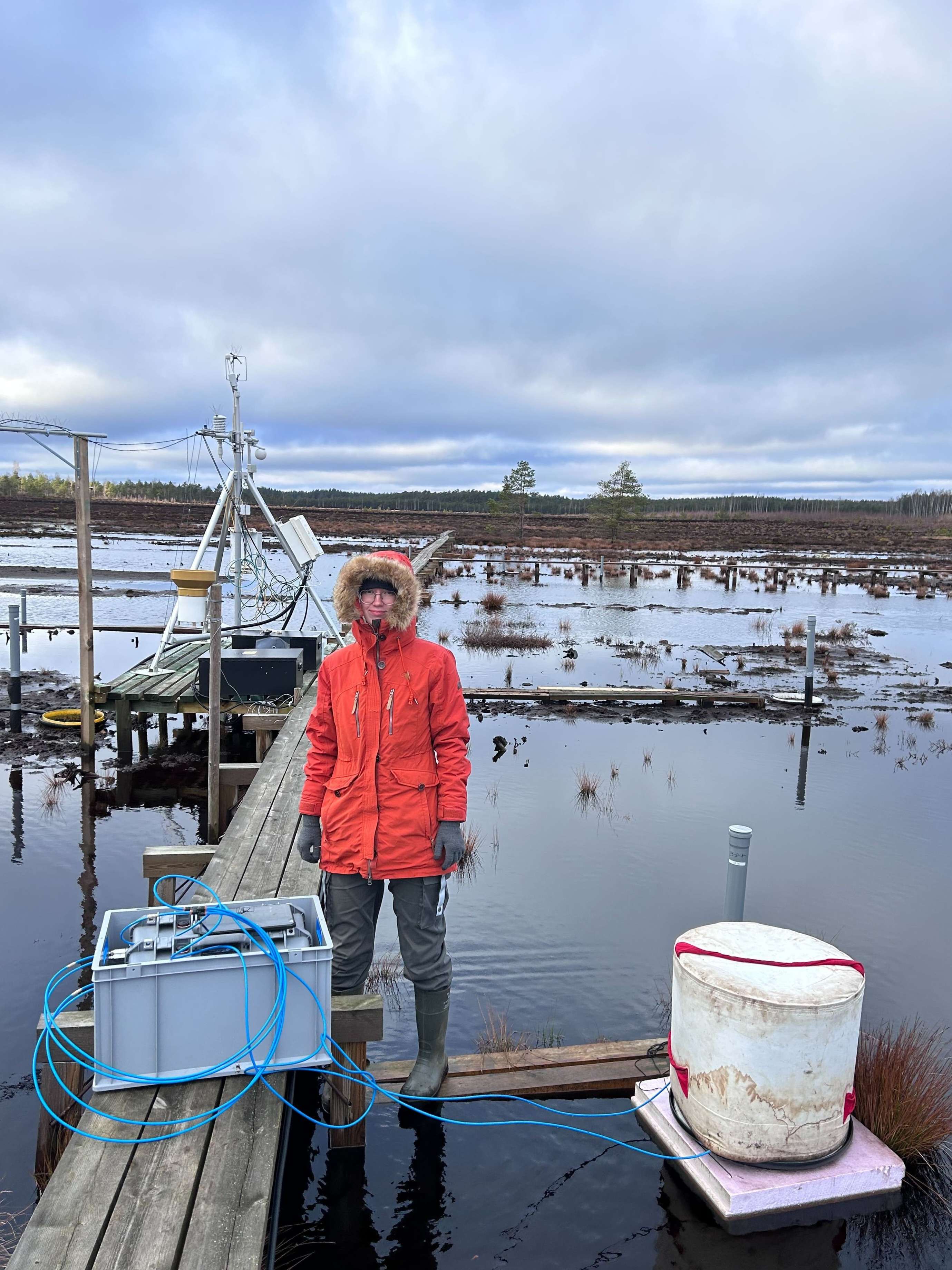 Ilona at the study site in Estonia.
Key takeaways from the article:
- A study by researchers from the University of Tartu and the University of California, Berkeley, showed that vegetation had not recovered significantly at the studied wetlands four years after restoration. Although restoring the water regime helps slow peat decomposition, this alone may not be enough.
- Vegetation struggles to recover naturally in former peat extraction areas because peat extraction removes much of the original plant cover and the material needed for plants to spread. In addition, the remaining acidic and nutrient-poor peat surface does not provide favourable conditions for plant growth.
- Vegetation plays an important role in wetland restoration: plants absorb carbon dioxide, support biodiversity and contribute to ecosystem functioning. If vegetation fails to recover, a wetland may continue to release more greenhouse gases into the atmosphere than it can absorb.
- After restoration, wetlands need to be monitored over the long term, and vegetation recovery may require active intervention, such as planting additional vegetation or transplanting peat mosses.
The study also helps the Centre of Excellence Futurescapes better understand how to restore former peat extraction areas and other degraded wetlands more effectively, supporting biodiversity and mitigating climate change.
Read the full article here.