As part of Green University Week, the University of Tartu hosted a discussion titled “Who Needs Nature Conservation?”, where Merle Karro-Kalberg, a member of our Landscape Biodiversity Group, also shared her thoughts as well.
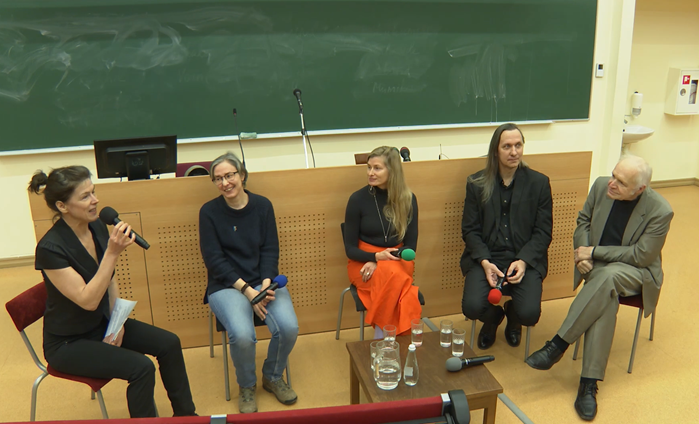 Discussion was moderated by Maie Kiisel.
Other participants included Eva-Liis Tuvi, lecturer in environmental protection and nature conservation at Estonian University of Life Sciences, Kalevi Kull, professor of biosemiotics at the University of Tartu, and Priit Zingel, associate professor of hydrobiology at the Estonian University of Life Sciences.
Key points from the discussion:
Although cities cover about 3% of the Earth’s surface, they consume around 70% of the energy produced globally. To live more sustainably, we should focus on urban energy use, and nature-based solutions can significantly reduce cities’ energy demand. Excess water does not always need to be directed into pipes; it can be managed through green areas, and trees can be used to provide shade and cool cities. In this context, it is not enough to have just one protected area somewhere outside the city.
One way everyone can contribute to nature protection is by allowing part of their land, no matter how small, to develop into a natural habitat. Even in cities, areas can be left to develop over time, allowing species to adapt and find balance. Additionally, simply tolerating more biodiverse areas in urban spaces is already a contribution to protecting nature.
A common myth is that Estonian cities are already quite green. From a bird’s-eye view, this may seem true, but at the level of insects, the picture is very different. In reality, the situation is quite poor: cities may have large trees, but beneath them there is often only grass or bare soil. While large trees are a great value in urban environments, biodiversity also depends on what exists under those trees.
Watch the discussion here: