We are sharing the thoughts of our member Triin Reitalu from the discussion “Nature Restoration: The Truth and Justice of Estonia’s Bogs?” at the Opinion Festival.
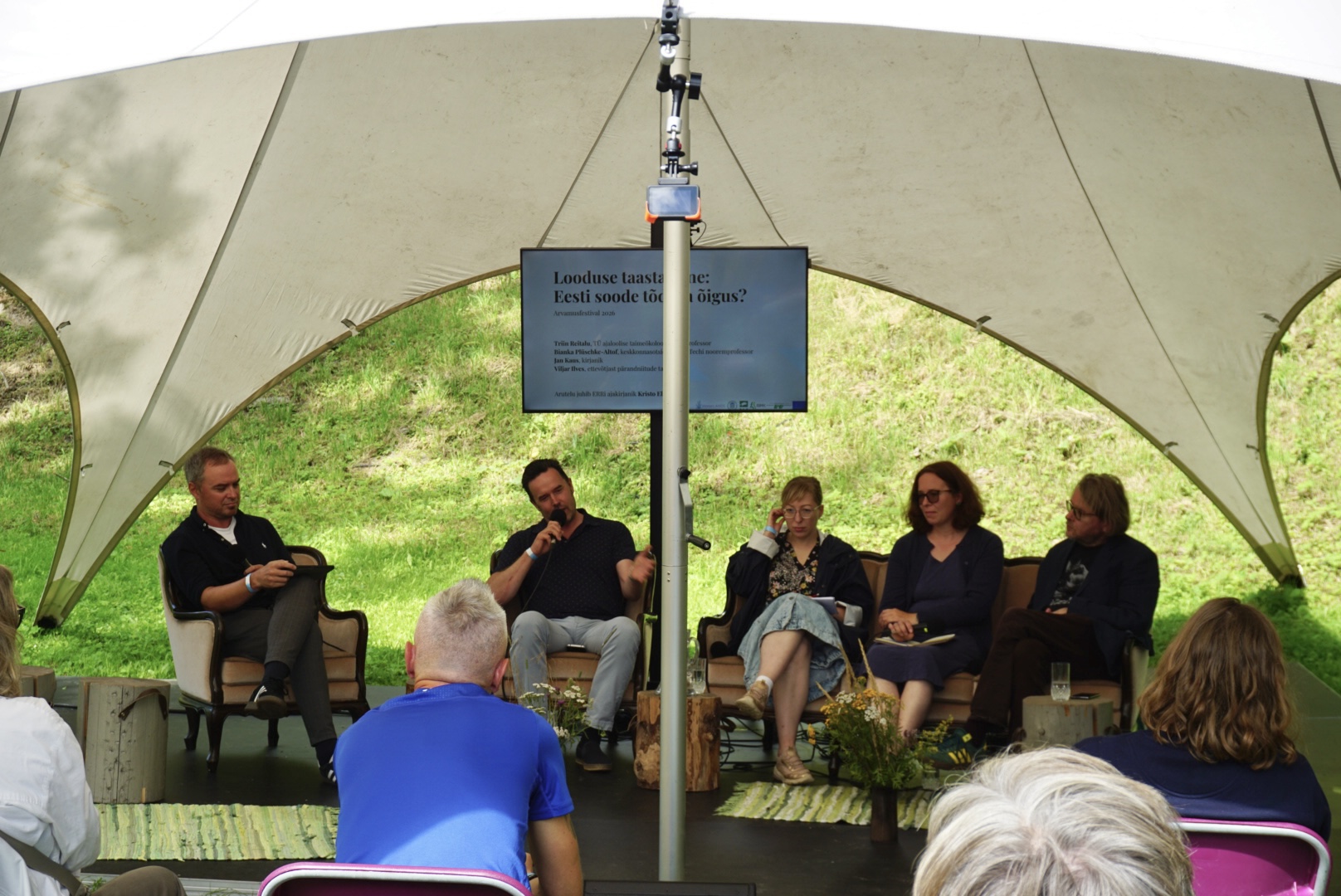 Discussion about nature restoration at Paide Opinion Festival. Photo author: Katariina Kuusaru.
- The aim of nature restoration is not to recreate something exactly as it was a hundred or a thousand years ago. The environment and climate have changed, and it is impossible to bring back past ecosystems exactly as they were. This means we cannot quickly turn exhausted peatlands back into bogs, but we can restore water levels and create suitable living conditions for aquatic plants, insects and birds.
- Restoration is not simply a matter of random experimentation. Our knowledge of ecology, hydrology and water regimes is sufficiently advanced to predict many outcomes with a reasonable degree of confidence. For example, if we clear overgrown vegetation from a floodplain meadow and start mowing it, we can be fairly certain that meadow plants and birds will begin to return. Although restoration work involves some uncertainty and room for error, it is not a process of trial and error.
- Every euro invested in restoration can generate €8–38 in benefits for society. At the same time, it is important to understand that these benefits may not go directly into the pocket of an individual businessperson or landowner. Instead, they take the form of broader societal benefits, such as a cleaner environment, better mental health, a stronger immune system and opportunities to spend time in nature.
A few striking figures from the discussion:
- over the past hundred years, the area covered by bogs and other mires in Estonia has decreased threefold;
- The area of wooded meadows has decreased a thousandfold;
- Old-growth forests account for just two per cent of Estonia’s forests.
The discussion was organised by the Estonian Fund for Nature.
Listen to the discussion here (in Estonian):