At June 26, the Head of our Landscape Biodiversity Group, Aveliina Helm, served as the opponent for Pasi Pouta’s doctoral dissertation at the University of Helsinki, which focused on vascular plant diversity in urban grasslands.
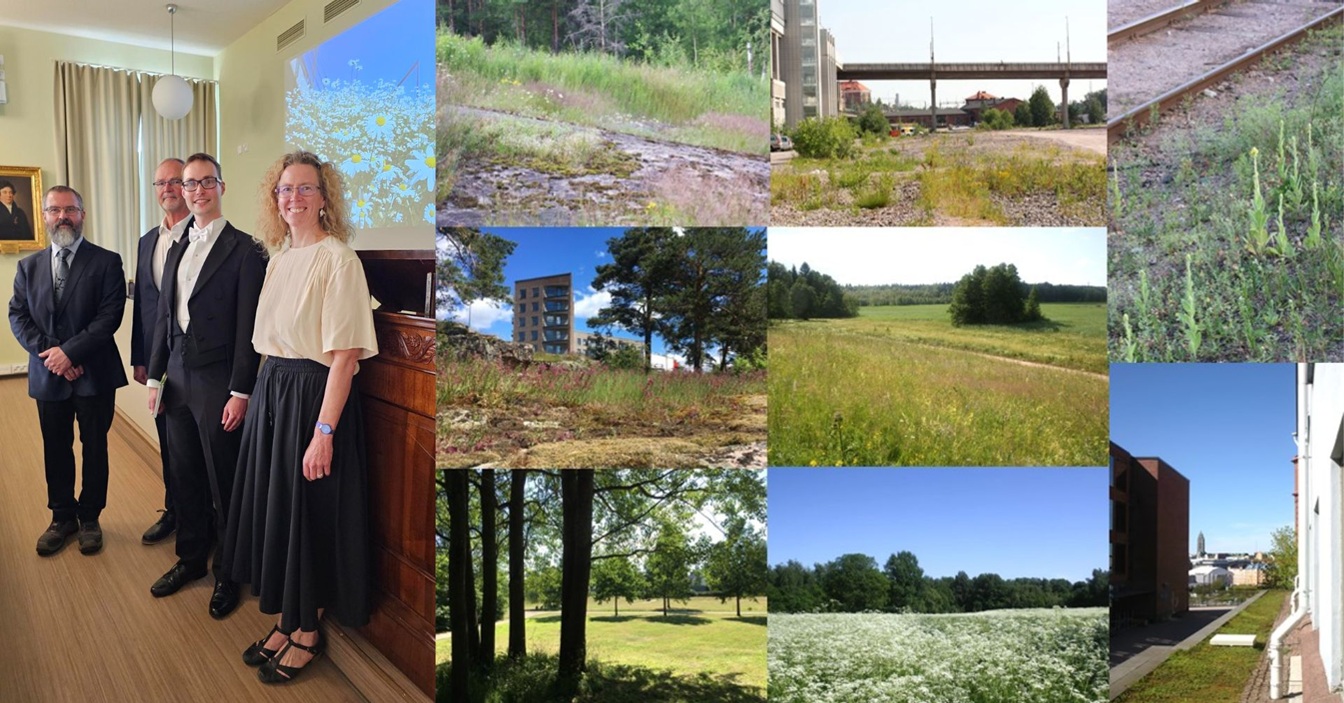 The PhD was successfully defended! The grassland photos come from Pasi Pouta’s PhD thesis.
Supervised by Johan Kotze and Jussi Lampinen, the dissertation offers several simple, science-based recommendations for increasing biodiversity in urban grasslands:
- Protect old species-rich meadows. Creating new urban meadows is important, but they cannot replace long-established semi-natural grasslands that support many rare plant species.
- Mow less frequently. Reducing mowing frequency and sowing native meadow seed mixtures helps create more species-rich grassland vegetation.
- Manage meadows consistently. Species-rich grasslands require appropriate, long-term management because simply sowing meadow seeds is not enough.
- Reduce excess nutrients in the soil. One of the greatest threats to plant diversity in cities is nutrient enrichment, especially phosphorus. It favours a few fast-growing weedy species while pushing out more delicate meadow plants.
- Create different types of meadows. Biodiversity benefits from a variety of habitats, including dry, moist, rocky and mesic meadows, as different species thrive under different conditions.
- Create green networks, not isolated patches. Plants need connected habitats to spread. Urban planning should integrate meadows into connected green networks. Road verges are particularly important, as they are often surprisingly species-rich and serve as corridors for plant dispersal.
The more diverse grasslands cities have, the more resilient urban environments become to climate change. In addition, well-managed meadows are often less expensive to maintain than intensively mown lawns.