On December 4, members of our Centre of Excellence participated in the conference “Sustainable Soil and Land Use – From Soil Science to Land Use Governance” held at the Estonian University of Life Sciences.
The head of our Landscape Biodiversity Working Group, Aveliina Helm, took part in a panel discussion focusing on where we want to get to in Estonian soil and land use.
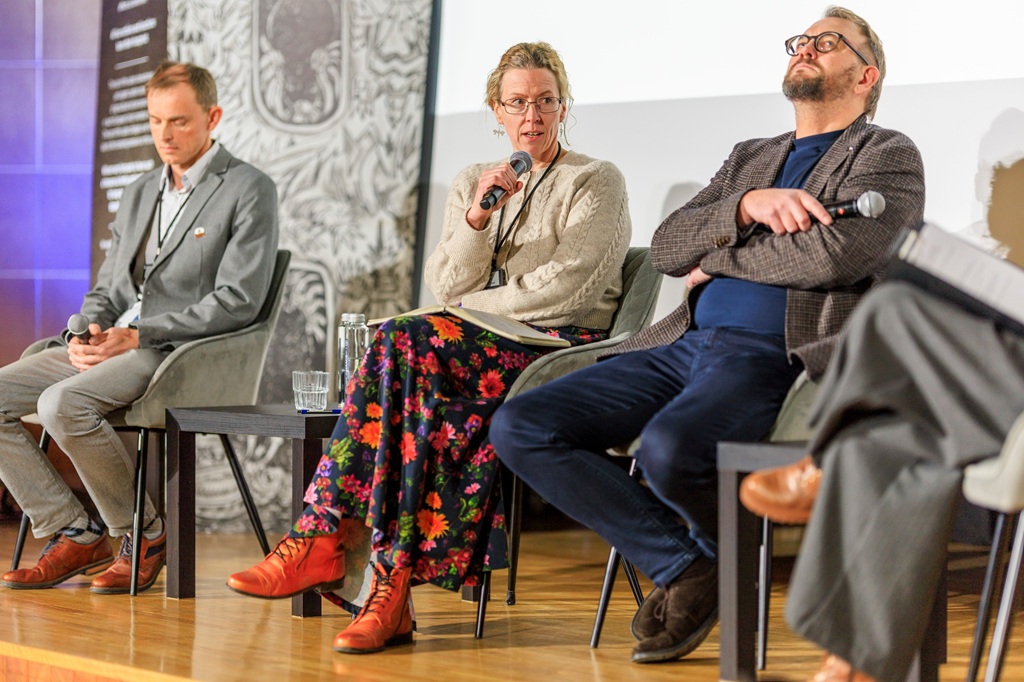 Aveliina taking part in a panel discussion.
Aveliina’s thoughts from the discussion:
Personalised land use and smarter decisions based on existing data are without a doubt one future path in land-use planning. It is more practical to move increasingly towards precision land use, where current scientific advances make it possible to give different recommendations even for different parts of the same field. At FutureScapes, we are trying to develop solutions that would bring information about the condition of a specific plot of land, ecosystem services, leaching risk, and soil biota to every land user.
It is very important how people talk about environmentally friendly activities. At the moment, we increasingly see how discussions on environmental issues disappear under strong polarisation, and every new environmental topic is considered the next wave of “green madness”.
We have not been very strategic in our land use when it comes to large-scale planning – our cities have spread onto agricultural land and will continue to do so unless this is regulated. Any kind of regulation is not bad, because it is through regulation that we can all live well together.
The panel discussion that Aveliina participated in can be watched to here:
The head of our Agricultural Research and Policy Research Group, Ants-Hannes Viira, participated in another panel discussion on land-use synergies and challenges.
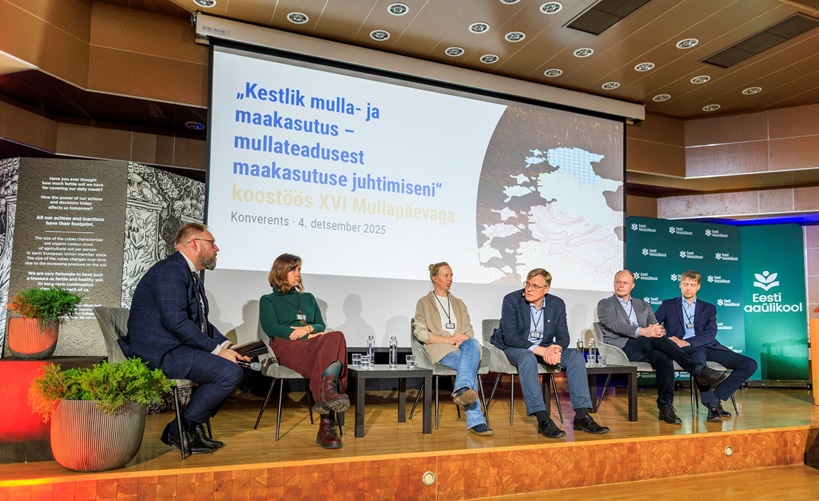
Ants-Hannes taking part in the panel discussion.
Ants’s thoughts from the discussion:
Competition and synergy will always coexist in land use. Within the agricultural sector, companies constantly compete for the same land. We have a lot of land that land users do not own themselves, and for these lands, those offering the highest rental price are usually selected. This can lead to a situation where a land user who has invested in the land and improved soil quality may not get to enjoy the results of their work, simply because the competition is so intense.
It would be necessary to calculate how much and what kind of agricultural land we need to ensure food supply for the Estonian population during a multi-year crisis. In addition, it would be important to map where we can no longer import fertilisers and plant protection products from, as this also affects food security during times of crisis.
The panel discussion that Ants participated in can be watched to here: